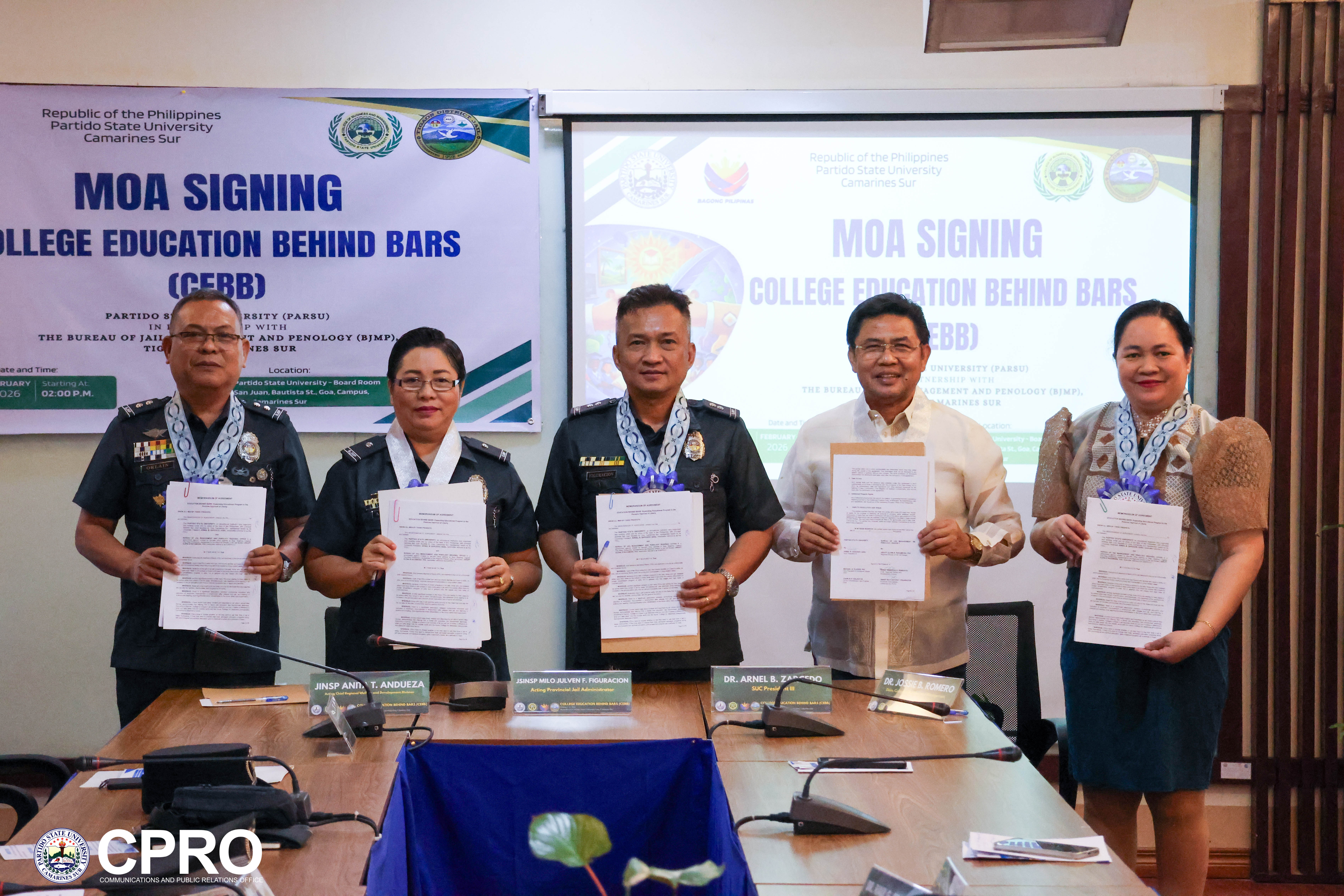
In a landmark move toward inclusive and rehabilitative justice, Partido State University (ParSU), through its College of Business and Management (CBM), and the Bureau of Jail Management and Penology (BJMP) Regional Office V officially launched the College Education Behind Bars (CEBB) on February 13, 2026. The initiative was formalized through the signing of a Memorandum of Agreement (MOA) at the ParSU Board Room, institutionalizing the delivery of college education within jail facilities.
Under the program, CBM will provide academic instruction, supervision, and learning modules to qualified PDLs, enabling them to pursue a Bachelor of Science in Entrepreneurship (BSEnt). Academic credentials issued under the program will not disclose incarceration status to ensure equal employment opportunities upon release.
During the ceremony, Dr. Rina A. Abner-Puerta, former Dean of CBM and proponent of the CEBB, presented the rationale of the initiative, emphasizing that many PDLs come from economically marginalized sectors with limited access to formal education and employment opportunities. She noted that expanding access to higher education inside correctional facilities addresses systemic barriers that contribute to reoffense.
She highlighted that the program is a structured academic intervention aligned with the University’s mandate, integrating tertiary education, life-skills formation, and entrepreneurship training to equip PDLs with recognized credentials and employable competencies. Accordingly, correctional education represents a strategic shift from mere confinement to evidence-based rehabilitation that supports long-term reintegration and public safety.
The MOA was executed by ParSU President Dr. Arnel B. Zarcedo and BJMP Acting Chief of the Regional Welfare and Development Division, JInsp. Anita Aduenza, representing Regional Director Elena B. Rocamora, PhD. University officials, CBM administrators and BSEnt teaching personnel, and representatives from BJMP — including the Provincial Office and Tigaon District Jail — were also present to witness the ceremonial signing, underscoring the shared institutional commitment to program implementation.
Among those in attendance was JSInsp. Alvin Orlain, Acting Warden of Tigaon District Jail,who played a key role in the initiative’s groundwork through close coordination with ParSU CBM during the planning and preparatory stages. As the primary pilot site of the CEBB, the Tigaon District Jail has readied its facility to accommodate structured academic sessions. Jail authorities will oversee logistical arrangements, learner supervision, and the integration of the academic program into regular correctional operations.
In his message, President Zarcedo underscored that the initiative is anchored on the principle that “education must never stop at a prison gate,” emphasizing that the University’s mandate extends beyond traditional classrooms. He stressed that ParSU carries a responsibility not only to educate those who are free to enroll but also to reach individuals behind bars, noting that “a person’s mistake should never permanently imprison his or her future.”
He further highlighted employability and reintegration as core objectives of CEBB, stating that when PDLs return to society, “they must come out prepared” and “come out employable.” According to Zarcedo, education inside correctional facilities ultimately benefits the broader community, as “rehabilitation is not achieved by confinement alone,” and public safety is strengthened not only by custody but by transformation.
The University President also affirmed that ParSU’s commitment goes beyond instructional delivery. The institution, he said, will provide mentorship and guidance, and affirmed that ParSU "will treat learners as students, not as cases, not as statistics, but as human beings capable of change.”
JInsp. Aduenza emphasized that the partnership is firmly anchored on constitutional guarantees, national statutes, and international standards that recognize education as a fundamental right, including for incarcerated individuals. She underscored that “education remains one of the most powerful tools for personal and social transformation,” stressing that the initiative reflects a shared institutional commitment to inclusive access to learning.
“Through this initiative, we affirm our shared belief that persons deprived of liberty deserve opportunities for growth, self-improvement, and hope,” Aduenza stated.
She further highlighted that providing access to higher education goes beyond academic instruction. “By providing access to higher education, we are not only equipping them with academic knowledge but also empowering them to rebuild their lives, rediscover their sense of purpose, and prepare for successful reintegration,” she concluded.
By embedding structured academic and skills-based training into jail operations, CEBB seeks to improve literacy and numeracy levels, develop employment-ready competencies, reduce recidivism, and strengthen family and community reintegration. Modeled after the College Education Behind Bars framework implemented in Davao, the ParSU-BJMP partnership advances correctional education in the Bicol Region by aligning these goals with a structured, evidence-based approach, thereby reinforcing both institutions’ shared commitment to rehabilitation.#