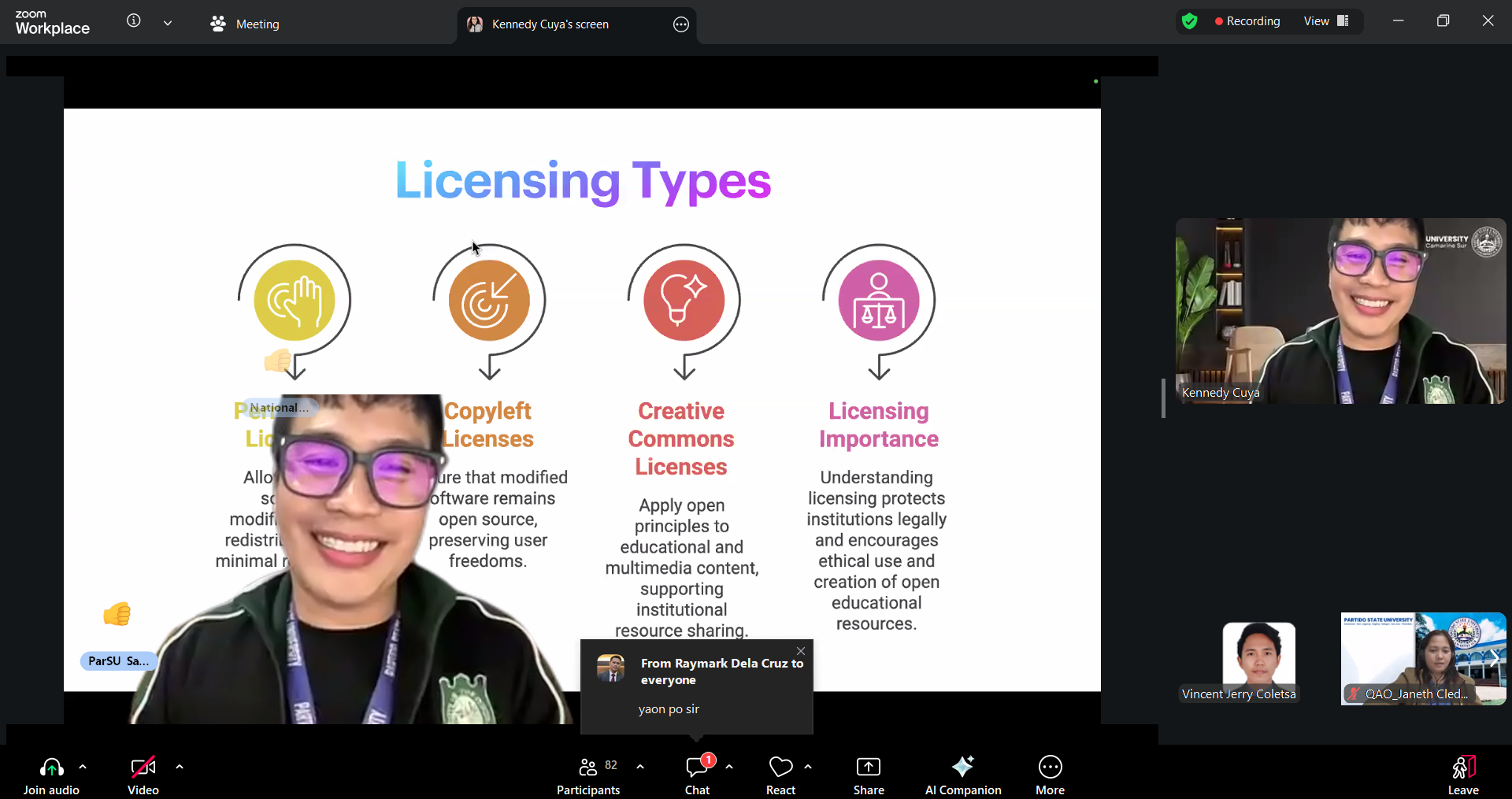
The Partido State University, through its Quality Assurance Office (QAO), successfully conducted the Orientation Workshop on PQA Requirements for Licensed Software and Open-Source Alternatives on February 13, 2026, via Zoom. The initiative represents a strategic step toward strengthening lawful, secure, and sustainable digital governance across the University, promoting the responsible adoption of licensed and open-source software as a long-term institutional standard. It also forms part of the University’s continuing preparations for the Philippine Quality Award (PQA), aligning digital practices with national quality and governance benchmarks.
In her opening message, QAO Director Ms. Janeth A. Cledera underscored that strict adherence to licensed software requirements is a non-negotiable standard under the PQA framework.
“This workshop is a critical step in our journey towards excellence. The PQA standards require us to [demonstrate] integrity in every aspect of our operations, and one of its non-negotiable conditions is the exclusive use of licensed software,” Caldera emphasized. She further cautioned that “a single lapse in the area [can disqualify] us from eligibility,” stressing that compliance safeguards not only qualification but also integrity, security, and reliability of the University’s systems.
Underscoring the governance implications of digital risk, ParSU President Dr. Arnel B. Zarcedo framed the initiative as a matter of institutional leadership and accountability. “If our systems are vulnerable, our records cannot be trusted; and if our records cannot be trusted, then our governance is weakened,” he stated.
He clarified that the responsible use of licensed software “is not only an IT concern—it is a leadership, quality assurance, and ethical responsibility.” Highlighting the strategic value of open-source platforms, he added that these solutions allow the University to remain “lawful, efficient, and innovative at the same time,” reiterating that the ultimate objective is not merely to qualify for the Philippine Quality Award but to become an institution truly worthy of it.
Serving as the first resource speaker, Dr. Kennedy Cuya, highlighted the strategic value of the open-source software—defined by its publicly accessible and modifiable source code—in promoting transparency, reduces vendor lock-in, and supporting scalable institutional growth.He introduced parsuopensource.vercel.app, an institutional portal for accessing free tools like OnlyOffice for documentation and Jamovi for data processing, enabling lawful and cost-efficient digital operations.
Meanwhile, Mr. Leo Constantine Bello, addressed compliance vulnerabilities within the University’s current digital ecosystem. He identified key risks such as the use of unlicensed software, informal downloads in laboratories, and decentralized procurement practices. His presentation detailed the legal, financial, and reputational consequences of non-compliance, and called for strengthened asset governance, centralized monitoring systems, and enforceable accountability mechanisms.
The workshop was facilitated by Mr. Charles Jasthyn C. De La Cueva, Administrative Officer IV of the QAO, who presented a structured Institutional roadmap anchored on legal compliance, standardized institutional protocols, and a defined implementation timeline. He also outlined a five-phase framework: Kick-off and Communication; Self-Checking and Submission; Validation, Repair, and Procurement; Consolidation and certification; and PQA EIF Submission.
Culminating in a clear directive to department chiefs, deans, and ICT coordinators,the initiative mandates the establishment of a centralized protocol for managing software assets.The coordinated approach signals ParSU’s institutional resolve not only to achieve recognition, but to institutionalize compliance as an operational norm.
As President Zarcedo noted, the objective extends beyond earning distinctions but about embedding quality as a daily practice, where integrity fortifies the system that sustain excellence.
With Reports: 𝘔𝘦𝘭𝘺𝘯 𝘚𝘰𝘱𝘩𝘪𝘢 𝘚𝘢𝘯 𝘑𝘰𝘴𝘦 - 𝘊𝘗𝘙𝘖 𝘐𝘯𝘵𝘦𝘳𝘯